

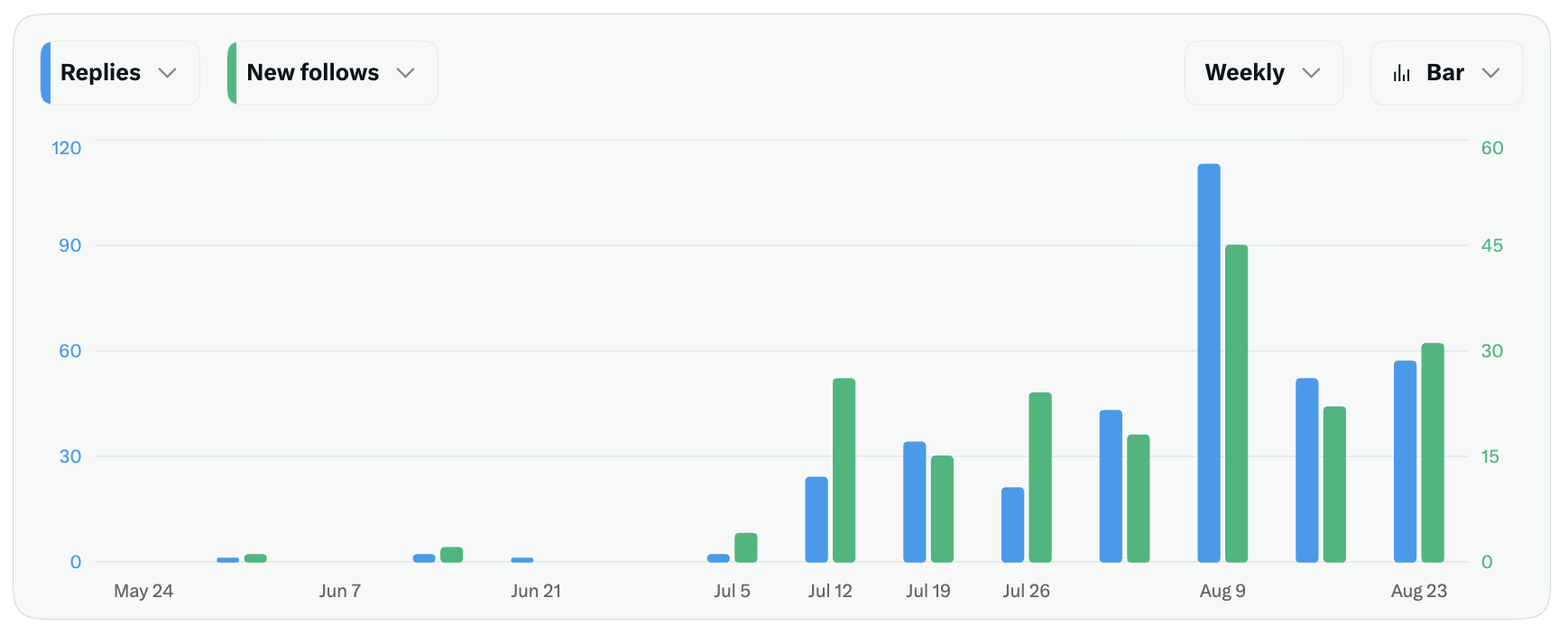
Most growth advice for X tells you to post more. If you are under roughly 15,000 followers, that advice is backwards. Your posts are capped by an audience you do not have yet. Your replies are not.
This is the full reply-first playbook: the mechanism that makes it work, how to pick who you reply to, the exact search operators that surface the right conversations, what to actually write, and the daily routine that holds it together.
Replying puts you in front of someone else's audience. Posting puts you in front of your own. When your own is small, borrowed reach is the only reach that compounds — so spend your time choosing where to reply, not writing more posts.
01Owned reach vs borrowed reach
Every piece of writing you publish on X draws from one of two pools.
Owned reach is your own post. Its ceiling is your follower count, filtered by however many of them the algorithm decides to show it to. If 500 people follow you, a good post reaches some fraction of 500, plus whatever spills over from reposts.
Borrowed reach is your reply. It sits inside someone else's post, and its ceiling is their audience. Reply under an account with 80,000 followers and the pool you are drawing from is 160 times larger than your own — before you have earned a single new follower.
The arithmetic is worth being concrete about, so long as you read it as illustration rather than a promise. Say you post twice a day to 500 followers and see a few hundred impressions each. That is your day. Now say you leave fifteen replies under posts that are actively being read. Even if most land flat, the two or three that catch are being read by people who have never heard of you. Nothing about your posting changed. The pool you were fishing in did.
This is also why the strategy has an expiry date. Once your own audience is large enough that owned reach is substantial, the balance shifts back toward posting. Reply-first is the tactic for getting to that point, not a permanent way of working.
02Pick the accounts you live under
The single biggest lever is not how many replies you leave. It is whose posts you leave them under. Reply under the wrong accounts and volume will not save you.
You are looking for accounts one layer out from where you already are: big enough that their audience contains people you would want following you, small enough that a reply is not buried under four hundred others within a minute.
| Account size | What happens to your reply | Worth it? |
|---|---|---|
| Roughly your size | Seen by a handful of people, most of whom already know you | Good for relationships, not for reach |
| 5–20× your size | Enough audience to matter, few enough replies that yours is visible | This is the band to live in |
| 100×+ your size | Hundreds of replies within minutes; yours is invisible unless you are extremely early | Occasionally, and only if you are fast |
Build a private List of fifteen to thirty accounts in that middle band, in one niche you can speak to credibly. Private, because you do not need anyone to know who you are studying. One niche, because the whole point is that the same audience keeps seeing you until your name is familiar. Someone who sees you once forgets you. Someone who sees you nine times over three weeks follows you.
That List becomes your feed. Open it instead of the home timeline, which is optimised to keep you scrolling rather than to show you where a reply would land well.
03Find the conversations (search operators)
Most people scroll and hope. X has a full search syntax that will do the filtering for you, and almost nobody in the reply-guy discourse mentions it. These work in the normal search box.
| Operator | What it does |
|---|---|
from:username | Only posts from one account |
min_faves:100 | Only posts above a like threshold — a proxy for a thread that is actually moving |
min_replies:10 | Only posts that already have a conversation in them |
-filter:replies | Exclude replies, so you get original posts you can reply to |
filter:follows | Only accounts you already follow |
lang:en | Restrict to one language |
since:2026-09-01 | Only posts after a date |
Chain them. A few that earn their place in your bookmarks:
Live conversations in your niche
indie hacker min_faves:150 min_replies:15 -filter:replies lang:en
Posts with real traction and an existing thread, so your reply arrives somewhere people are already reading rather than into silence.
Questions you can actually answer
"how do you" saas pricing min_replies:5 -filter:replies
A question with a handful of replies is the highest-value target on the platform. The author wants an answer, the audience is reading for the answer, and a genuinely useful one is remembered.
People complaining about the problem you solve
"wasting time" OR "so tedious" twitter growth -filter:replies min_faves:20
Do not pitch into these. Be useful in them. The pitch is your profile, which they will click if the reply was good.
A saved search you check twice a day beats an hour of scrolling, because it removes the decision that actually costs you: is this thread worth my reply?
04Timing: the window that matters
Replies are not shown purely in the order they arrive, but arriving early still compounds in your favour, for a mechanical reason: the earlier you are, the longer your reply is visible to everyone who opens the thread afterwards, and the more time it has to gather the engagement that keeps it near the top.
Arrive late to a thread with three hundred replies and yours is on page four. Nobody scrolls to page four.
Practically, that means you want to be reading when the accounts on your List are posting. Do not guess at this. Look at when their posts that did well went out, and work in that window. If the people you are targeting are in North America and you are not, this is the single scheduling decision that determines whether the strategy works for you at all.
Being early is not the same as being fast. A rushed reply that arrives in ninety seconds and says nothing is worse than no reply — it costs you the slot and the impression.
05What a reply worth posting looks like
The bar is simple: your reply should be worth reading by someone who does not care about you. Agreement is not worth reading. "Great thread" is not worth reading. Something the author did not say is worth reading.
Formats that consistently earn attention
- The specific counter-example. The post makes a general claim; you have a case where it broke, and you say what happened. Not "it depends" — the actual case.
- The number from your own work. You ran the thing being discussed and you have a real figure. This is the highest-trust reply on the platform and almost nobody has one.
- The extension. You accept the point and take it one step the author did not take.
- The question that opens the thread up. Not a question you could answer yourself — one the author will want to answer, because the answer is interesting to them.
- The concrete how. The post says what to do; you say how, in enough detail that someone could go and do it.
Formats that quietly cost you
- Restating the post in different words. Reads as filler even when you meant it.
- Pure agreement. "This." "So true." "Underrated take." Nobody clicks a profile after that.
- The unprompted plug. Mentioning your product in a thread that was not about your product is the fastest way to be ignored by exactly the audience you were trying to reach.
- The essay. If your reply is longer than the post, write your own post.
Length is not the variable people think it is. One sharp sentence with a real detail in it outperforms four paragraphs of throat-clearing. Write the detail, delete the throat-clearing.
06Your profile is the conversion step
Everything above buys you one thing: a profile click. What happens next is entirely down to a page you can fix in twenty minutes and then stop thinking about.
Someone arrives cold, having read one good reply. They give you a few seconds. In that time they need to work out who you are, what you do, and why they should care.
- Bio: what you do and who for, in plain words. Not adjectives. Someone should be able to repeat it back after reading it once.
- Avatar: a face, cropped close enough to read at the size a reply actually renders at.
- Pinned post: your single best piece of proof. Not your launch announcement — the thing that makes a stranger think you know what you are talking about.
- Recent replies: visitors scroll them. If the last twenty are one-word agreement, the good reply that brought them there looks like an accident.
07A 25-minute daily routine
The reason reply-first fails is almost never the tactic. It is that it is unstructured, so it expands to fill an afternoon, and then you stop. Bound it.
- Open your List, not the home feed (1 min). The home feed is designed to hold you, not to help you.
- Run two saved searches (4 min). Skim for threads with momentum and an unanswered question.
- Pick eight to twelve targets (5 min). Choosing is the work. Do not reply to everything you open.
- Write the replies (12 min). Roughly a minute each. If one takes longer than three, it wanted to be a post.
- Reply to everyone who replied to you (3 min). This is the step people skip, and it is the one that turns reach into relationships.
Do that on weekdays and leave the weekend alone. Consistency over three weeks beats intensity over three days, because familiarity is the thing you are actually building and familiarity needs repetition, not volume.
08Mistakes that stall accounts
- Automating the posting. Tools that publish replies for you put your account at risk and produce writing nobody wants to read. Draft with help if you like; press the button yourself.
- Volume without targeting. A hundred replies under the wrong accounts does less than fifteen under the right ones, and it is far more work.
- Chasing only the largest accounts. Satisfying, ineffective. You are one of four hundred.
- Spreading across five niches. Nobody sees you often enough anywhere to remember you.
- Never following up. The reply is the introduction. If you never speak to the person again, you collected an impression, not a contact.
- Quitting at week two. The curve is flat and then it is not. Most people leave during the flat part.
09How Replivio fits
Everything above is doable by hand. The expensive part is step three of the routine — deciding which of the forty things in front of you is worth a reply. That is judgement, repeated dozens of times a day, and it is where the twenty-five minutes turns into ninety.
Replivio is a Chrome extension that does that filtering while you browse X normally. ReplivScore ranks the conversations in your feed by whether they are still gaining attention. ReplivScore+ flags the person inside a thread worth knowing, not just the post. And it drafts a reply that knows what you are building, in your voice, which you edit before posting.
You always post yourself. It never auto-posts, and it never touches your DMs. The point of the strategy is that a human wrote the reply.
One reply did 14.1k views — vs 873 for the best original post on the same account. See how conversation scoring works and how it drafts the reply, or start with my X account →
10FAQ
How many replies a day should I actually leave?
Fewer than the advice you have read, and more deliberately chosen. Eight to twelve well-targeted replies you can sustain every weekday will beat fifty scattered ones, because the goal is being seen repeatedly by the same audience rather than being seen once by many.
How long before replies show results?
Expect the first few weeks to look flat. You are building familiarity with a specific audience, and familiarity is cumulative. If nothing has moved after a month of consistent, well-targeted replying, the problem is usually the accounts you chose or the profile people land on — not the volume.
Will replying a lot get my account restricted?
Replying is normal use of the platform. What creates risk is automation — tools that post on your behalf, or bursts of near-identical replies. Write your own and post them yourself and you are doing what the platform is for.
Should I reply to accounts far bigger than mine?
Sparingly. Under a very large account you are competing with hundreds of replies within minutes. The five-to-twenty-times band gives you a real audience and a real chance of being read.
Does this still work if I post nothing at all?
It gets you the profile click, but the profile has to reward it. You need enough of your own writing that a visitor can tell what you think. Replies bring people to the door; something has to be behind it.
Is a reply tool cheating?
It depends what the tool does. Something that decides where to reply is filtering, which is a judgement problem software is good at. Something that writes and publishes for you removes the one thing that makes the reply worth reading. Draft with help, post as yourself.
